
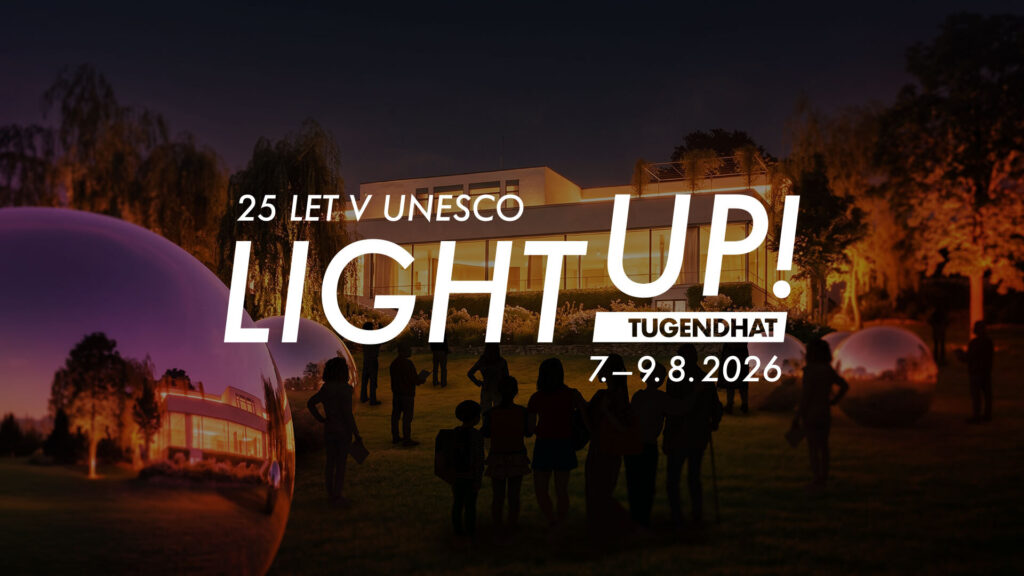
Experience Villa Tugendhat like never before! The Brno icon will come to life with the Light Up Tugendhat light show, which culminates this year’s celebrations of 25 years since its inscription on the UNESCO World Heritage List. For this occasion, the villa’s garden will be visually connected to the neighbouring gardens of Löw-Beer Villa and Arnold Villa. For three days and three nights, this space will be transformed into a place full of art and creativity.
Visitors can expect a kinetic and mirror installation complemented by a musical programme directed by the “Maraton hudby” festival. Accompanying activities in the villas will also introduce other UNESCO sites of Brno and South Moravia.
Every evening from nine o’clock, the gardens will be illuminated by light installations and video mapping on the facades of all three villas.
Come celebrate the uniqueness of cultural heritage in Brno!
Event programme for Friday–Sunday:
• 10:00–18:00 Freely accessible installations in the gardens and programme in the villas
• 15:00–21:00 Music Marathon programme
• 21:00–24:00 Light installations, videomapping
• 00:00–01:00 End of the event and closing of the gardens
Friday 7. 8. 2026
- 10:00 tour of Villa Tugendhat for chidren and parents
- 11:00–18:00 UNESCO tours of Villa Tugendhat
- 11:00 workshop Composing a space
- 13:00 guided tour of the exhibition Mies in picture
- 15:00 Maraton hudby concert: Kluka, Kluka, Heřman
- 18:00 Maraton hudby concert: D.EEJAY + launch of the photographic Portfolio of David Židlický
- 21:00–24:00 videomapping launch of the videomapping at 21:00)
Saturday 8. 8. 2026
- 10:00 tour of Villa Tugendhat for chidren and parents
- 11:00–18:00 UNESCO tours of Villa Tugendhat
- 11:00 workshop Composing a space
- 13:00 guided tour of the exhibition Mies in picture
- 15:00 Maraton hudby concert: UMCACA
- 18:00 Maraton hudby concert: dance performance of Revealed: Novotná & Cemerek
- 21:00–24:00 videomapping
Sunday 9. 8. 2026
- 10:00 tour of Villa Tugendhat for chidren and parents
- 11:00–18:00 UNESCO tours of Villa Tugendhat
- 11:00 workshop Composing a space
- 13:00 guided tour of the exhibition Mies in picture
- 15:00 Maraton hudby concert: Hazafele
- 20:00 Maraton hudby concert: Kluka, Kluka, Heřman
- 21:00–24:00 videomapping
Friday 7. 8. 2026
- 10:00–18:00 workshop: I Write Like Mendel! – a calligraphy workshop to practice Kurent, the script in which G. J. Mendel wrote his manuscript
- 10:00–23:00 self-guided tour of the villa
- I’m Listening to Janáček – 10 models with QR codes in the villa’s garden
- 16:00 Maraton hudby concert: Jan Fic
- 19:00 Maraton hudby concert: The Petersons
- 21:00–24:00 videomapping
Saturday 8. 8. 2026
- 10:00–18:00 workshop: I Write Like Mendel! – a calligraphy workshop to practice Kurent, the script in which G. J. Mendel wrote his manuscript
- 10:00–23:00 self-guided tour of the villa
- I’m Listening to Janáček – 10 models with QR codes in the villa’s garden
- 16:00 Maraton hudby concert: ADAMS (Adam Stašek)
- 19:00 Maraton hudby concert: DJ Mirror & MC Scissal
- 21:00–24:00 videomapping
Sunday 9. 8. 2026
- 10:00–18:00 workshop: I Write Like Mendel! – a calligraphy workshop to practice Kurent, the script in which G. J. Mendel wrote his manuscript
- 10:00–23:00 self-guided tour of the villa
- I’m Listening to Janáček – 10 models with QR codes in the villa’s garden
- 16:00 Maraton hudby concert: DJ ZIMA
- 19:00 Maraton hudby concert: Children’s Cimbalom Band ZUŠ Kyjov
- 21:00–24:00 videomapping
Friday 7. 8. 2026
- 10:00–18:00 discounted admission to the exhibition
- 10:00–18:00 White Carpathians Nature House: activities for children and adults
- 10:00–18:00 demonstration of the Strážnice blueprinting technique + workshop
- 17:00 Maraton hudby concert: Klára Veselá & Luciano Mayaci
- 18:00–20:30 videopresentation of South Moravian UNESCO tangible and intangible heritage sites in the stairwell lobby
- 20:00 Maraton hudby concert: VeHiBa
- 21:00–24:00 videomapping
Saturday 8. 8. 2026
- 10:00–18:00 discounted admission to the exhibition
- 10:00–15:00 Ride of the Kings workshop
- 10:00–18:00 White Carpathians Nature House: activities for children and adults
- 10:00–18:00 demonstration of the Strážnice blueprinting technique + workshop
- 17:00 Maraton hudby concert: Tibor Žida
- 18:00–20:30 videopresentation of South Moravian UNESCO tangible and intangible heritage sites in the stairwell lobby
- 20:00 Maraton hudby concert: Ritmo Factory
- 21:00–24:00 videomapping
Sunday 9. 8. 2026
- 10:00–18:00 discounted admission to the exhibition
- 10:00–18:00 White Carpathians Nature House: activities for children and adults
- 10:00–18:00 demonstration of the Strážnice blueprinting technique + workshop
- 17:00 Maraton hudby concert: Rozálie
- 18:00–20:30 videopresentation of South Moravian UNESCO tangible and intangible heritage sites in the stairwell lobby
- 19:00 Maraton hudby: Geraldine Schnyder Quartet
- 21:00 Maraton hudby: Kožená & Rattle – concert screening
- 22:00–24:00 videomapping
The event is also suitable for families with children.
The videomapping will begin on Friday, 7 August 2026 at 21:00, in the garden of Villa Tugendhat.
Due to limited capacity, you must reserve or purchase tickets for individual tours and workshops at Villa Tugendhat.
Brno has a strong position within UNESCO, thanks to:
-
Villa Tugendhat (World Cultural Heritage)
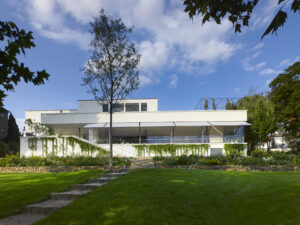
The Villa Tugendhat, built in 1929–1930 for the couple Greta and Fritz Tugendhat according to the design of the German architect Ludwig Mies van der Rohe, was inscribed on the UNESCO World Heritage List on 16 December 2001, as the only historical heritage of modern architecture in the Czech Republic.
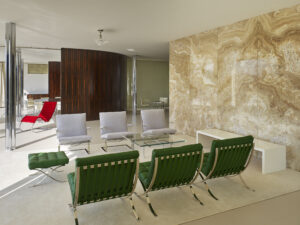
The uniqueness of the Brno villa lies in its formal architectural purity, timeless concept, setting in a natural framework and mutual interweaving of spaces, but also in the technical and structural solutions and use of noble and exotic natural materials. The Villa Tugendhat is not only an iconic building in the context of Brno’s modern architecture, but also the opus magnum of its architect. In 2010–2012, the Villa Tugendhat underwent restoration and renovation, which returned it to its appearance at the time of its completion in 1930.
As an installed monument of modern architecture, it offers its visitors not only traditional sightseeing tours, but also a wide range of programmes: music, dance and theatre performances, film screenings and educational programmes for schools and grammar schools. The technical floor of the villa is also used as an exhibition and lecture hall, focused on professional public presentations on the topic of modern and contemporary architecture.
Villa Tugendhat meets criteria 3 and 4 from the list of criteria for UNESCO inclusion:
- Ad 3: The German architect Mies van der Rohe applied radically new concepts of modernism, triumphant in the concept of residential architecture, which was of fundamental importance for the current and future development of world architecture.
- Ad 4: Modernism in the 1920’s influenced architecture in a fundamental way and the work of Ludwig Mies van der Rohe played an important role in its spread and worldwide acceptance. The villa is also an example of modern residential architecture of the 20th century, aimed at improving the quality of living space, both with its new concept and the use of technical equipment. The inventory of the villa and the perfection of craftsmanship place the building in the highest aesthetic category.
-
Leoš Janáček Archive (registered in the UNESCO Memory of the World international register since 2017)
The Leoš Janáček Archive is an extremely important part of the collections of the Department of Music History of the Moravian Museum. In 2017, it was inscribed in the international UNESCO Memory of the World Documentary Heritage Register for its uniqueness and integrity. Leoš Janáček is currently one of the most performed opera composers in the world. However, it is not only his operas, such as Jenufa, Katya Kabanova, The Cunning Little Vixen, The Makropulos Case and From the House of the Dead, that are celebrated on world stages, but also his famous Glagolitic Mass and the orchestral compositions Taras Bulba and Sinfonietta.
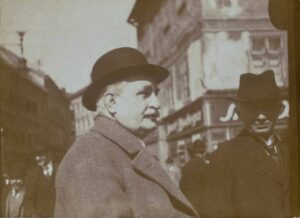
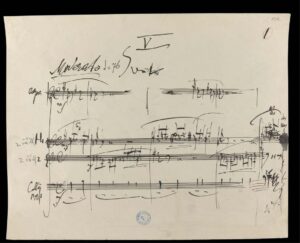
The archive preserves manuscripts and period copies of all of Janáček’s compositions, opera librettos, the composer’s literary and professional studies, Janáček’s notebooks and records of the so-called “speech tunes”. It also includes his extensive correspondence – an incredible 15 000 items – and a library, providing essential information on cultural and social life in Brno and in the context of the whole of Europe and enriching numerous scientific fields, including musicology, ethnography, history, sociology, psychology and political science. A substantial part of the documents was donated to the Moravian Museum in 1932 by the composer’s wife Zdeňka Janáčková. Thanks to gradual and systematic additions, the collection now represents an almost complete archive documenting the work and life of this unique figure in the world history of music.
Written by: Mgr. Ondřej Pivoda, Ph.D.
https://www.mzm.cz/oddeleni-dejin-hudby -
Moll’s map collection (also listed on the UNESCO Memory of the World Register from 2023)
The Moll Collection is one of the most important atlasses preserved in Central Europe. It was created in Vienna in the mid-18th century by the diplomat and collector Bernard Paul Moll (1697–1780). The collection contains more than 12 000 maps, plans, veduta, topographical views and other graphic sheets, mostly from the 16th–18th centuries. With its scope, systematic arrangement and quality of the works represented, it represents an extraordinary testimony to geographical knowledge and visual representation of the world in the early modern period.
The core of the collection is made up of maps and views depicting the territory of the Habsburg Monarchy and the Holy Roman Empire. The exceptional nature of the collection lies not only in the quantity and quality of the collected documents, but also in their arrangement. Moll created an extensive composite atlas in which he linked maps with pictorial views of cities, landscapes and important buildings. Thanks to this, it is possible to follow not only the development of cartography, but also the contemporary perception of space and landscape. Numerous handwritten notes and descriptions of individual sheets made by the collector himself are also of exceptional value and provide a unique insight into the way of working and thinking of an 18th -century scholar.
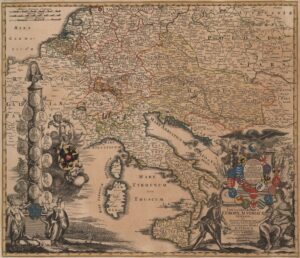
Due to its exceptional world value, uniqueness, scope and significance as a document of the cultural and scientific history of Europe, the Moll Collection was inscribed on the International Register of the UNESCO Memory of the World Programme in 2023. The inscription recognised not only the exceptional preservation of the collection, but also its significance for the study of cartography, the history of collecting, visual culture and the transformations of European space.
The collection is now stored in the Moravian Regional Library in Brno, which has been making it available to researchers and the general public for a long time. A significant part of the collection has been digitized and is freely available through the library’s map portal at mapy.mzk.cz, where interested parties can explore individual maps, views and other graphic documents online. Until 24 July, it is also possible to see the exhibition Europa Austriaca, Pictures of Central Europe and more from the Bernhard Paul Moll collection, which brings the collection closer to the lay public.
Written by: PhDr. Anna Mrázová
https://duha.mzk.cz/clanky/pribehy-mollovy-sbirky-zapsane-na-seznam-svetoveho-dedictvi-unesco
-
Brno “UNESCO City of Music” (UNESCO Creative Cities Network in the field of music)
Brno has been a part of the UNESCO Creative Cities Network (UCCN) as a UNESCO City of Music since 2017. This prestigious international network was established in 2004 with the aim of supporting cooperation between cities that perceive culture and creativity as key tools for sustainable development. It brings together hundreds of cities from all over the world in eight creative fields – music, literature, film, design, gastronomy, media arts, architecture and crafts, and folk art.
By receiving the title of UNESCO City of Music, Brno has committed to developing the city’s musical life in the long term, supporting the cultural and creative industries, strengthening international cooperation and making music accessible to the widest possible audience. The award is a recognition not only of Brno’s rich musical history associated with names such as Leoš Janáček and Pavel Haas, but also of its contemporary live music scene, major festivals, educational institutions, orchestras, duos, clubs and independent music initiatives.
Membership in the UNESCO network also opens up opportunities for Brno to cooperate internationally with other UNESCO Cities of Music. Through joint projects, exchange programmes and sharing of good practice, the city actively participates in the development of culture as an important element of quality urban life and sustainable development.
UNESCO nominations:
-
Milan Kundera’s Library on the UNESCO Memory of the World Documentary Heritage List
The Milan Kundera Library, which opened on 1 April 2023 in the Moravian Library, is a globally unique space with more than 3 000 publications of Milan Kundera’s works, an extensive archive of the reception of his work in the form of critiques published in the world media, and part of his documentary archive, which contains the author’s correspondence with, for example, Federico Fellini, Fernando Arrabal, François Truffaut. In 2025, it was visited by more than ten thousand visitors and the library has also established itself as a research and international workplace. The Milan Kundera Library is a place where Kundera’s work can not only be studied, but also newly interpreted in the context of European culture, philosophy and history.
Written by: PhDr. Anna Mrázová
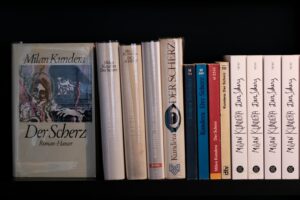
Autor: PhDr. Anna Mrázová
-
Gregor Johann Mendel’s manuscript
The nomination was submitted by the Old Brno Abbey to the Order of St. Augustine, where the manuscript is preserved as a collection item. Gregor Johann Mendel wrote the manuscript in his own hand as a basis for two lectures on his experiments with cross-breeding of peas, which he delivered on 8 February and 8 March 1865 at the Natural Science Society in Brno. It is the only preserved complete manuscript in which Mendel systematically explains his discoveries and places them in the overall context of his work. The document is not only a fundamental scientific source of the 19th century, but also directly documents the emergence of a new scientific field – genetics. Mendel’s laws of inheritance, formulated here, influenced the development of biological sciences, evolutionary theory and other fields from agriculture to medicine to criminology.
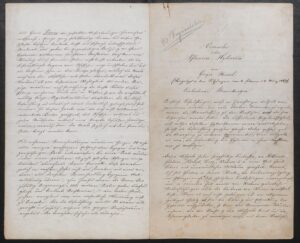
The manuscript is of great documentary value, including its visual perspective – it illustrates how a scholar of that era prepared a scholarly text, including the graphic presentation of tables and diagrams. For security reasons, the original is not on display; a digital version is available to the public. The manuscript was digitised in high resolution in 2017 and is available online at: https://mendel-genetics.cz/rukopis-gregor-johann-mendel/.
The programme is taking place with the support of the City of Brno, under the patronage of Mayor Markéta Vaňková, Governor of the South Moravian Region Jan Grolich, and the Czech National Commission for UNESCO.
The event’s partners are the Brno Region Museum and the Music Marathon.
