
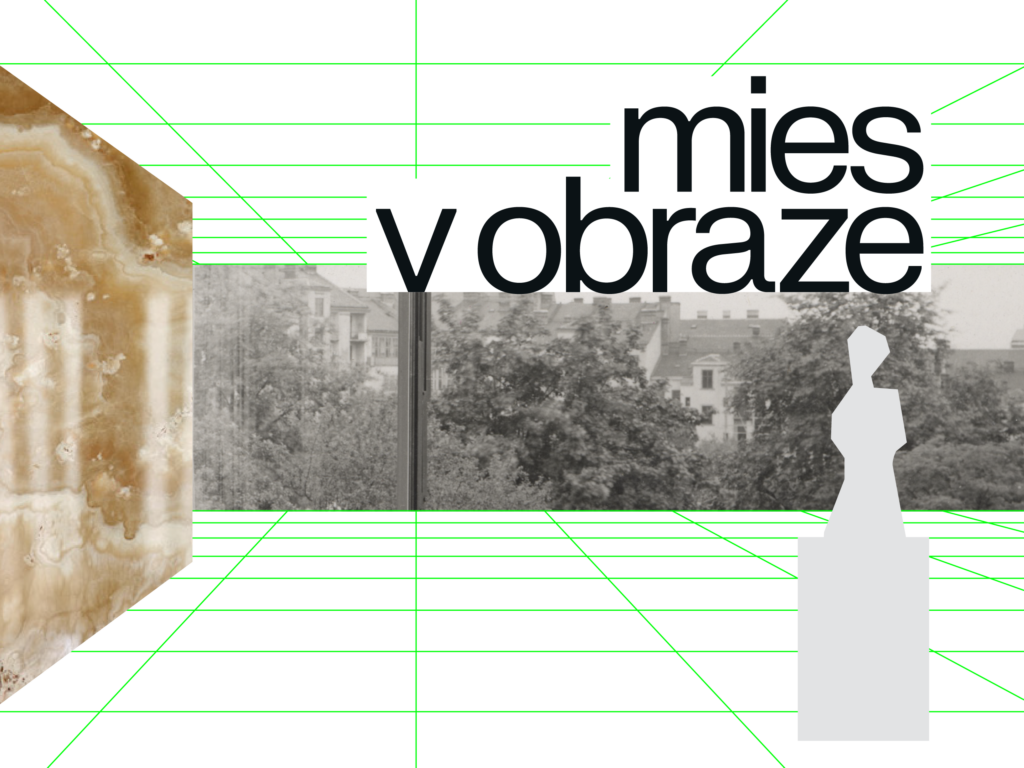
Mies worked with the techniques of collage and photomontage throughout his career – beginning with his photomontages for a competition for a Bismarck monument in Bingen am Rhein in 1910, continuing via his visionary proposal for a glass skyscraper on Berlin’s Friedrichstraße in 1922, and concluding with the collages for his final realized project, the Neue Nationalgalerie in Berlin in the 1960s.
Seven of the exhibited projects date to Mies’s time in the United States in the years 1938–1969. But the collages from his American period are more than just working sketches. Although they could be used to present proposals to clients, they can also be seen as autonomous visual works made from a variety of materials. They combine perspective drawings, wood veneers, photographs of the landscape, and reproductions of works by artists whom Mies admired: Paul Klee, Pablo Picasso, Wilhelm Lehmbruck, Wassily Kandinsky, and Aristide Maillol, among others. Thanks to all these factors, the collages can articulate proportions, a sense of depth, and the building’s relationship to its surroundings. They are also reminders of Mies’s close ties to the European avant-garde, in particular Constructivism, Dada, and De Stijl.
The selected collages all show a view from the interior, through large glass walls, onto the landscape outside. As with Mies’s realized projects, architecture here is clearly not an isolated object, but a means by which man relates to his surroundings. In his designs, Mies does not seek to dominate nature, but to create a spatial framework in which the landscape can naturally enter the building’s interior. His studies for the Resor House in Wyoming, for a “Museum for a Small City,” for the Bacardi company’s administration building in Cuba, for the Georg Schäfer Museum in Schweinfurt, and for the Neue Nationalgalerie in Berlin all work with a similar concept of space, one that characterizes Villa Tugendhat as well, with the glass surface simultaneously blurring and strictly defining the boundary between interior and exterior. Although Mies did not create any collages of the Brno villa, the curators’ selection consciously emphasizes the exhibited works’ connection with the exhibition venue.
This lesser-known aspect of Mies’s architectural practice has previously been studied by such authors as Phyllis Lambert, Andres Lepik, Barry Berdoll, and Martino Stierli, but it was first presented in exhibition form in 2016–2017 at Mies van der Rohe: Die Collagen aus dem Museum of Modern Art. Organized for the Ludwig Forum für Internationale Kunst in Aachen by a team including Brigitte Franzen and Andreas Beitin, the exhibition was subsequently shown at the Georg Schäfer Museum in Schweinfurt. The comprehensive exhibition catalogue represents an important resource for further research and study.
The exhibited works are presented as high-quality prints of the originals.
Exhibition opening
Wednesday 25 March 2026, 18.00
Exhibition duration
26 March – 13 September 2026
(accessible without reservation Tue–Sun, 10.00–18.00)
The exhibition is situated on the technical ground floor of Villa Tugendhat.
Exhibition authors: Michal Kolář, Barbora Benčíková, Veronika Svobodová
Villa Tugendhat Study and Documentation Center (SDC-VT) – Brno City Museum
Exhibition architecture and design: Atelier Zidlicky
Jazyková korektura: Neli Hejduk
Translation: Stephan von Pohl
Digital reproductions of collages: The Museum of Modern Art, New York / Scala Archives; Nationalgalerie, Staatliche Museen zu Berlin / bpk-Bildagentur
Photographs: David Židlický, Vladimír Buček – NPÚ-ÚOP Brno